
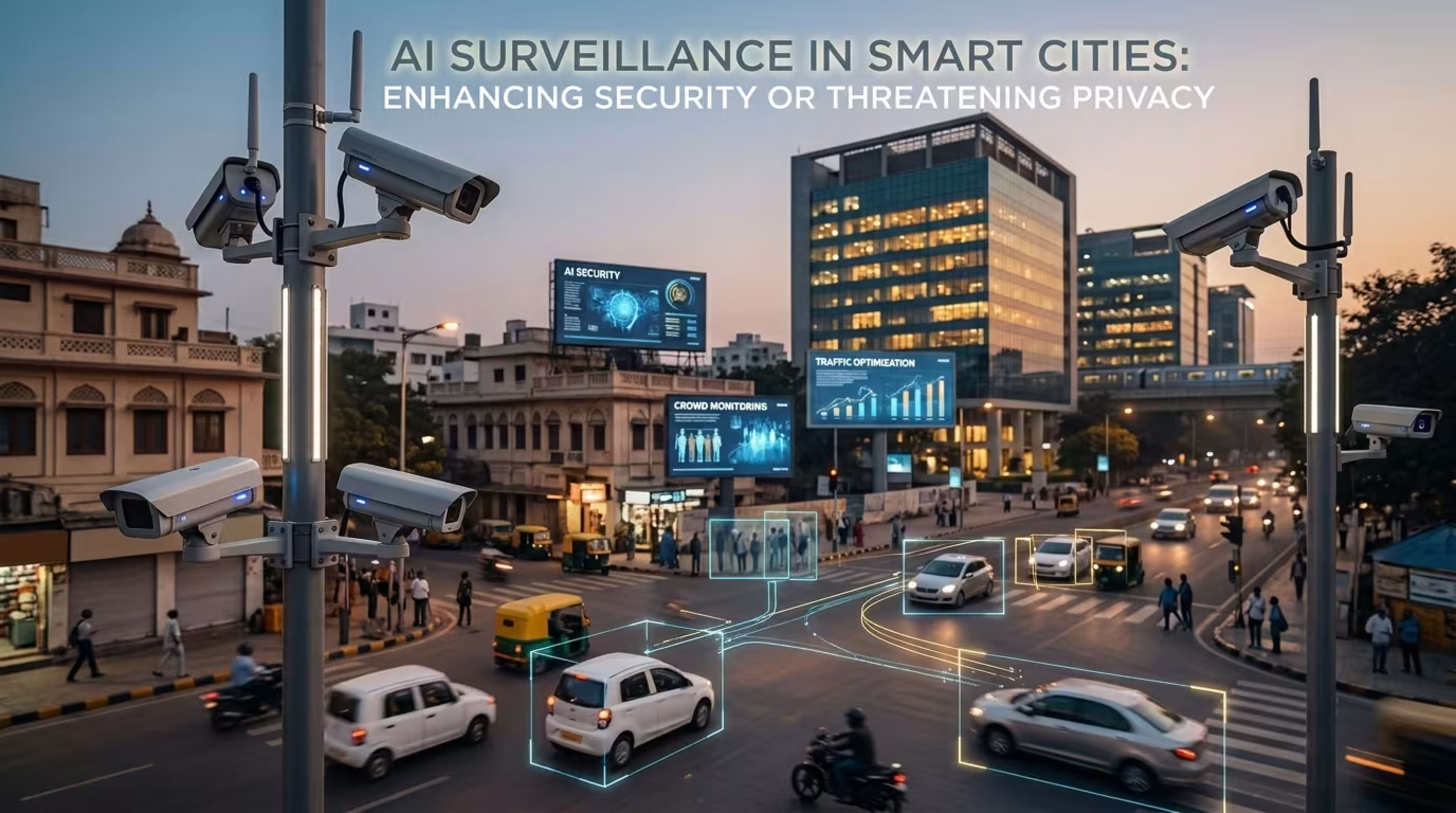
Introduction: The Rise of AI Surveillance
Walk through any modern city today, and you’ll notice cameras everywhere—traffic signals, railway stations, airports, and public spaces.
But these are no longer just cameras.
👉 They are AI-powered surveillance systems capable of:
Recognizing faces
Detecting suspicious behavior
Tracking movement in real time
In 2026, AI surveillance has become a cornerstone of smart city infrastructure in India. While it promises enhanced security and efficiency, it also raises serious questions about privacy and ethical use.
What Is AI Surveillance?
AI surveillance uses artificial intelligence and computer vision to monitor, analyze, and interpret video and sensor data in real time.
👉 In simple terms:
Smart cameras that don’t just record—they understand and act
What Are Smart Cities?
Smart cities use technology like:
AI
IoT (Internet of Things)
Big Data
👉 To improve:
Public safety
AI surveillance is a core part of smart city infrastructure.
👉Read more:- How AI Is Revolutionizing Traffic Management
How AI Surveillance Works (Step-by-Step)
1. Data Capture
Cameras and sensors collect video data continuously.
2. Edge AI Processing
Instead of sending data to the cloud:
👉 Edge AI processes video locally in real time
➡️ Learn more: What Is Edge AI?
3. AI Analysis
Systems detect:
Faces
Objects
Behaviors
4. Real-Time Alerts
Authorities are notified instantly if:
Suspicious activity is detected
Rules are violated
Key Features of AI Surveillance Systems
✔ Facial Recognition
Identify individuals instantly
✔ Behavior Analysis
Detect unusual or suspicious actions
✔ Crowd Monitoring
Analyze crowd density and movement
✔ License Plate Recognition
Track vehicles in real time
Benefits of AI Surveillance in Smart Cities
1. Improved Public Safety
AI helps:
Detect crimes before they escalate
Monitor high-risk areas
2. Faster Emergency Response
Authorities can act instantly based on alerts.
3. Crime Prevention
AI can identify suspicious behavior before crimes happen.
👉 Example:
Loitering detection
Unusual movement patterns
4. Traffic Law Enforcement
AI detects:
Red light violations
Over speeding
👉 Related:
➡️ AI Traffic Management in India
5. Crowd Management
Useful during:
Festivals
Protests
Public events
Real-World Examples
👉🇮🇳 India
Delhi
AI cameras for traffic monitoring
Facial recognition systems
Hyderabad
Advanced surveillance network
Real-time policing
Global
👉🇨🇳 China
Extensive facial recognition
Highly advanced surveillance
👉🇬🇧 UK
Smart CCTV systems
AI-based crime detection
The Privacy Debate: Major Concerns
While AI surveillance improves safety, it raises critical concerns:
1. Data Privacy
Huge amounts of personal data are stored.
👉 Risk:
Data breaches
Unauthorized access
2. Loss of Privacy
People are being monitored constantly.
👉 Concern:
“Are we being watched all the time?”
3. Facial Recognition Misuse
Wrong identification
Bias in AI systems
4. Mass Surveillance
Governments may track citizens excessively.
5. Lack of Transparency
People often don’t know:
What data is collected
How it’s used
Security vs Privacy: The Big Debate
Security Benefits | Privacy Risks |
|---|---|
Crime reduction | Constant monitoring |
Faster response | Data misuse |
Public safety | Loss of anonymity |
Smart policing | Government overreach |
👉 The challenge is finding the right balance
How to Balance Security & Privacy
1. Strong Data Protection Laws
Governments must regulate data usage
2. Transparency
People should know:
What data is collected
Why it’s used
3. Ethical AI Development
Avoid bias and misuse
4. Limited Surveillance Zones
Use only where necessary
5. Data Encryption
Protect sensitive information
Future of AI Surveillance
Smarter AI models
Better accuracy
Stronger privacy frameworks
Conclusion
AI surveillance is a double-edged sword.
👉 On one side:
Safer cities
Faster crime detection
Better public management
👉 On the other:
Privacy concerns
Ethical issues
Data risks
The future depends on how responsibly we use AI.
💡 The goal should be:
“Secure cities without sacrificing freedom.”