
Introduction
As artificial intelligence adoption accelerates, one critical question businesses and developers face is:
👉 Where should AI run — on the device or in the cloud?
This is where the debate between Edge AI vs Cloud AI becomes important.
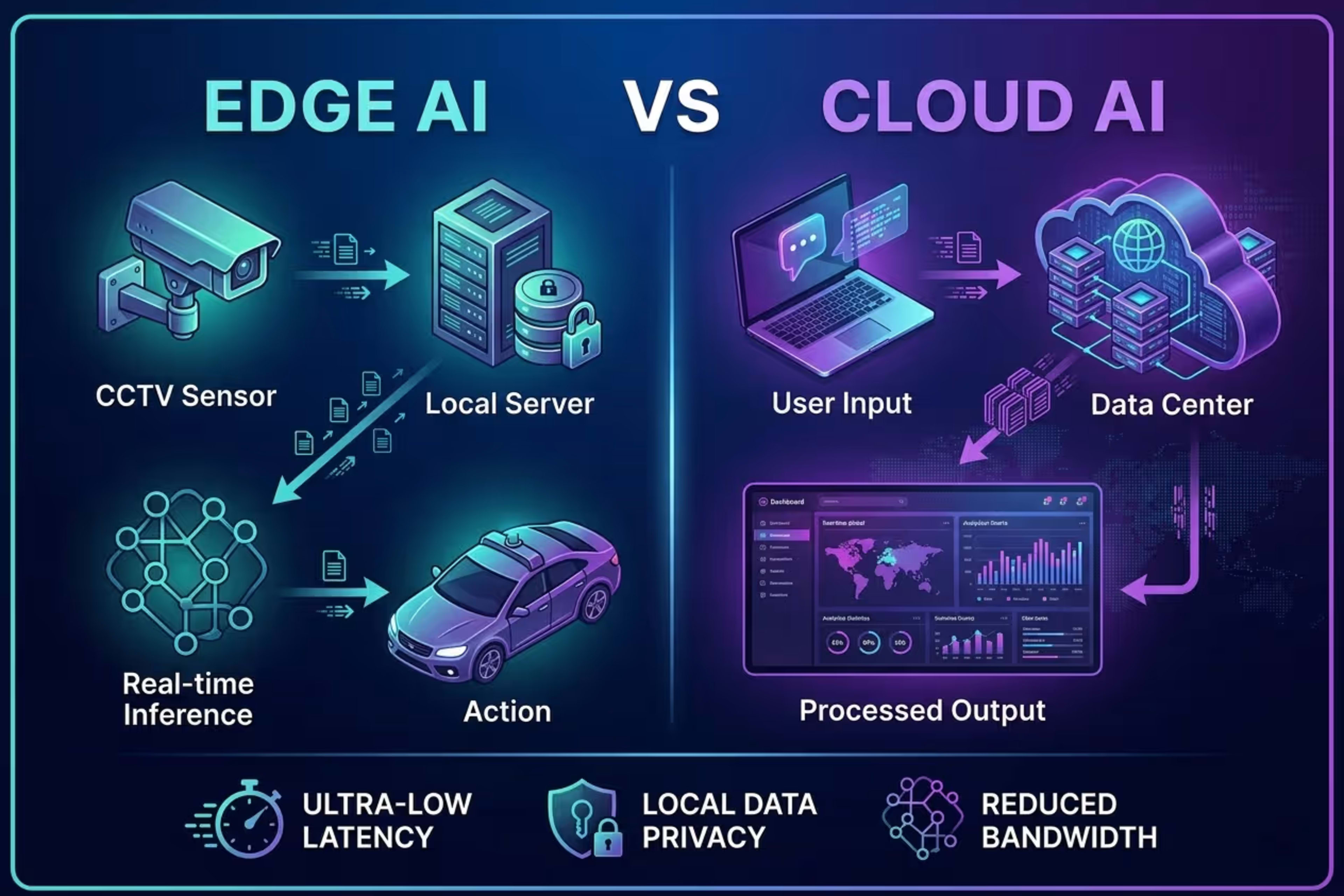
Both approaches power modern applications, from smart cities to chatbots, but they differ in speed, cost, scalability, and real-world use cases.
In this guide, you’ll learn:
Core differences between Edge AI and Cloud AI
Benefits and limitations of each
Real-world use cases
Which one is better for your use case
What Is Edge AI?
Edge AI refers to running AI models directly on local devices such as:
Smartphones
IoT sensors
CCTV cameras
Industrial machines
Instead of sending data to the cloud, Edge AI processes it on-device in real time.
Key Characteristics:
Real-time processing
Works without internet
Lower latency
Better privacy
👉 Example: Face recognition on your phone works instantly without sending data to servers.
👉 Learn the fundamentals here: ➡️ What Is Edge AI?
What Is Cloud AI?
Cloud AI relies on remote servers and data centers to process and analyze data.
Here’s how it works:
Data is collected from devices
Sent to cloud servers
Processed using powerful computing resources
Results sent back
Cloud AI is ideal for:
Large-scale data analysis
Training complex models
Applications requiring massive compute power
Edge AI vs Cloud AI: Key Differences
Feature | Edge AI | Cloud AI |
|---|---|---|
Processing Location | On-device | Remote servers |
Latency | Very low | Higher |
Internet Dependency | Minimal | Required |
Privacy | High | Moderate |
Compute Power | Limited | Very high |
Scalability | Limited | Highly scalable |
Cost | Lower long-term | Higher ongoing |
👉 The biggest difference is where data is processed — locally vs remotely.
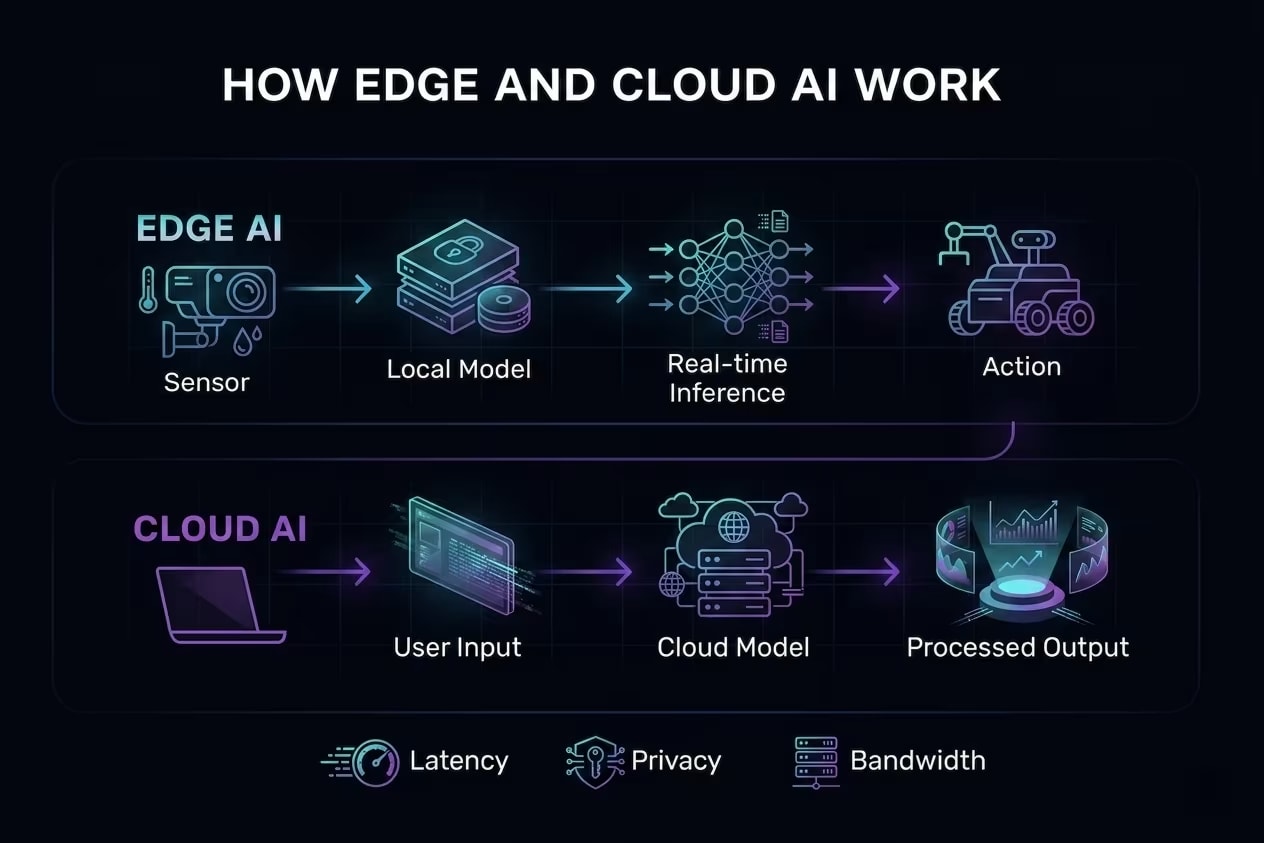
Deep Dive: How Edge AI Works vs Cloud AI
Edge AI Workflow
Data is collected by a device
AI model processes data locally
Instant decision is made
👉 Example: Traffic camera adjusting signals instantly
Cloud AI Workflow
Data is sent to cloud servers
Processed in centralized systems
Results sent back
👉 Example: Image recognition on cloud platforms
Advantages of Edge AI
⚡ 1. Ultra-Low Latency
Edge AI processes data instantly, making it ideal for:
Autonomous vehicles
Smart surveillance
Industrial automation
🔒 2. Better Privacy & Security
Data stays on-device, reducing exposure risks.
🌐 3. Works Without Internet
Perfect for remote or low-connectivity areas.
💰 4. Reduced Bandwidth Costs
No need to constantly send data to cloud servers.
Advantages of Cloud AI
🚀 1. Massive Computing Power
Cloud AI uses GPUs and data centers to handle complex models.
📊 2. Big Data Processing
Ideal for:
Analytics
Predictive modeling
AI training
📈 3. Scalability
Easily scale resources up or down based on demand.
🔄 4. Continuous Learning
Cloud systems improve models using large datasets over time.
Limitations of Edge AI
Limited hardware capabilities
Difficult to update models
Higher initial hardware cost
Limitations of Cloud AI
High latency
Internet dependency
Data privacy concerns
Bandwidth costs
Real-World Use Cases
🚗 Edge AI Use Cases
Edge AI is best for real-time decision-making:
Autonomous vehicles (instant reactions)
Smart cameras (real-time detection)
Wearable health devices
Smart factories
👉 These applications require instant responses without delay.
☁️ Cloud AI Use Cases
Cloud AI is ideal for heavy processing tasks:
Chatbots (like ChatGPT)
Big data analytics
Recommendation systems
AI model training
👉 These require large datasets and compute power.
Edge AI vs Cloud AI: Which One Should You Choose?
Choose Edge AI if:
You need real-time responses
Internet is unreliable
Privacy is critical
Choose Cloud AI if:
You need large-scale processing
You're training AI models
You need scalability
The Future: Hybrid AI (Edge + Cloud)
The real answer isn’t Edge vs Cloud…
👉 It’s Edge + Cloud working together
Modern systems use:
Edge AI → real-time decisions
Cloud AI → training & analytics
This hybrid approach delivers:
Speed + intelligence
Efficiency + scalability
Even engineers on platforms like Reddit highlight that:
“The future isn’t edge vs cloud — it’s both working together.”
Future Trends (2026–2030)
Rise of 5G-powered Edge AI
Growth of IoT ecosystems
AI-powered smart cities ➡️ Edge AI in India: How Smart Cities Are Becoming Truly Intelligent (2026 Guide)
On-device AI in smartphones
Distributed AI systems
👉 Expect a shift from centralized AI → distributed intelligence
Conclusion
Edge AI and Cloud AI are not competitors—they are complementary technologies.
Edge AI enables real-time, local intelligence
Cloud AI provides deep analysis and scalability
As AI systems evolve, the future lies in combining both approaches to build faster, smarter, and more efficient applications.