
Introduction: Why AI Agents Are Exploding in 2026
AI agents are quickly becoming one of the most important trends in artificial intelligence.
Unlike traditional AI tools that only respond to prompts, AI agents can take action, make decisions, and complete tasks automatically.
This shift is huge.
Instead of just asking AI for answers, you can now assign it work—just like a digital employee.
In this guide, you’ll learn:
What an AI agent really is (simple explanation)
How it works step-by-step
Real-world examples used today
Tools you can start using immediately
What Is an AI Agent? (Simple Explanation)
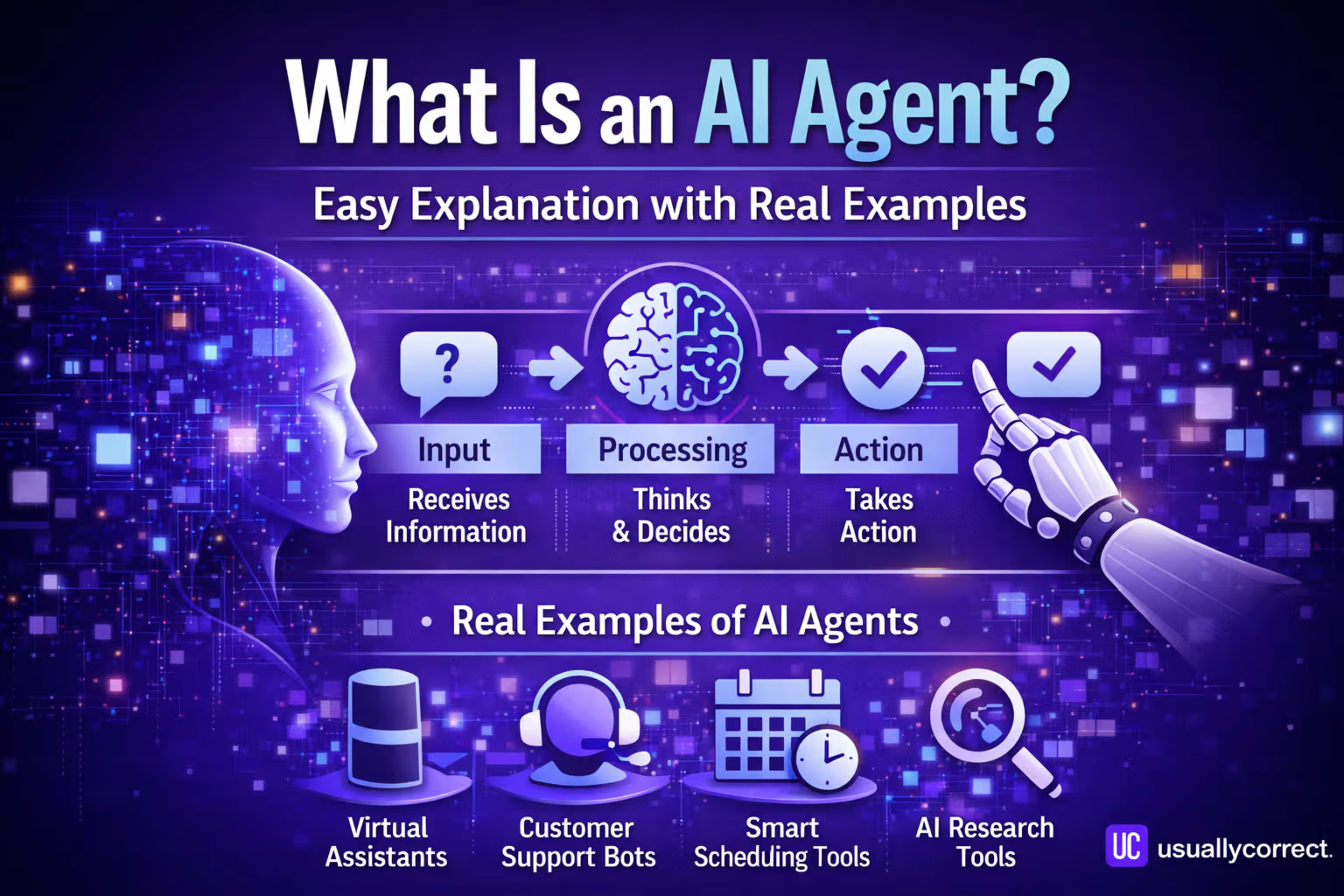
An AI agent is a software system that can understand a goal, plan steps, and take actions to achieve that goal automatically.
Simple way to understand it:
Chatbot → answers questions
AI Agent → does the work for you
👉 Example:
Instead of telling you how to book a flight, an AI agent can:
search flights
compare prices
select the best option
complete the booking
That’s why AI agents are often called “digital workers”.
How Does an AI Agent Work?
Behind the scenes, most AI agents follow a powerful loop:
1. Input (Understanding the Goal)
The agent receives your request
Example: “Find the cheapest flight to Delhi”
2. Planning
It breaks the task into steps:
search flights
compare prices
filter by time
3. Tool Usage
It interacts with tools like:
APIs
databases
websites
4. Execution
It performs actions based on the plan.
5. Memory & Iteration
It stores results and improves decisions if needed.
👉 This loop makes AI agents autonomous, not just reactive.
AI Agent vs Chatbot: Key Differences
Feature | Chatbot | AI Agent |
|---|---|---|
Purpose | Conversation | Task completion |
Action | ❌ No | ✅ Yes |
Autonomy | Low | High |
Example | Answering questions | Booking flights, automating workflows |
👉 Key takeaway:
Chatbots talk. AI agents act.
Real-World Examples of AI Agents
AI agents are not just theory—they’re already used in real life.
🔹 1. Autonomous Research Tools
Agents that:
search the web
summarize information
generate reports
🔹 2. Customer Support Automation
AI agents can:
resolve tickets
handle FAQs
escalate complex issues
🔹 3. Email & Productivity Assistants
They can:
write emails
schedule meetings
follow up automatically
🔹 4. Developer Agents
Tools like:
AutoGPT
LangChain-based agents
These can:
write code
debug errors
automate workflows
👉 These are already being used in production environments.
Read More How to Use AI Agents in Daily Life
Why AI Agents Matter in 2026
AI agents represent a major shift:
👉 From tools → autonomous systems
Instead of doing repetitive tasks manually, you can delegate them.
Real impact:
Businesses reduce operational cost
Teams automate repetitive workflows
Individuals become more productive
Many companies are already using AI agents to:
automate customer support
manage operations
scale without hiring
👉How Businesses Use AI Agents to Sell and Support Customers 24/7
Benefits of AI Agents
✅ Save Time
Automate repetitive tasks instantly
✅ Increase Efficiency
Complete tasks faster than humans
✅ Improve Accuracy
Reduce human errors
✅ Scalability
Handle multiple tasks simultaneously
Limitations of AI Agents
AI agents are powerful—but not perfect.
❌ Require Clear Instructions
Poor input = poor results
❌ Can Make Mistakes
Especially in complex or ambiguous tasks
❌ Dependency on Tools
Agents rely on APIs and integrations
❌ Privacy Concerns
Sensitive data must be handled carefully
👉 Human supervision is still important.
How to Start Using AI Agents (Beginner-Friendly)
You don’t need to be an expert to start.
🔹 Start with simple use cases:
writing emails
scheduling tasks
research automation
🔹 Try popular tools:
Zapier AI (workflow automation)
AutoGPT (autonomous agents)
ChatGPT tools & plugins
🔹 For developers:
You can build your own agents using:
OpenAI API
LangChain
vector databases
👉 Start small → then scale.
The Future of AI Agents
AI agents are evolving into digital coworkers.
In the near future, you may:
assign tasks to AI like a team member
automate entire business workflows
control systems using voice commands
Voice-based and multi-agent systems are growing rapidly.
👉 The future is not just AI tools—it’s AI working for you.
Conclusion
AI agents are changing how we interact with technology.
They don’t just provide information—they take action and get work done.
Final takeaway:
👉 AI agents help you do more with less effort
If you learn how to use them now, you’ll have a major advantage in the future.