Claude Opus 4.7 Release Overview

Claude Opus 4.7, released on April 16, 2026, by Anthropic, marks a significant upgrade over Opus 4.6, focusing on agentic coding, vision, and long-horizon tasks. It excels in handling complex software engineering with less supervision, precise instruction following, and self-verification of outputs. This comprehensive guide delves into the most impactful upgrades of Claude Opus 4.7, exploring how these advancements will reshape AI development, empower businesses, and foster a more responsible AI ecosystem. We will examine its superior performance metrics, its implications for complex problem-solving, and the critical role it plays in pushing the boundaries of AI safety.

Understanding the Evolution: From Previous Claude Versions to Opus 4.7

To truly appreciate the magnitude of Claude Opus 4.7's advancements, it's essential to understand its lineage. Anthropic has consistently prioritized safety and helpfulness in its AI models, building upon the foundations laid by earlier versions. Previous iterations of Claude, while powerful, often faced limitations in areas such as handling extremely long documents, intricate multi-turn conversations, and nuanced ethical considerations.

Claude Opus 4.7 addresses these limitations head-on. The development team has focused on refining the underlying architecture, incorporating novel training methodologies, and implementing advanced reinforcement learning techniques. This has resulted in a model that is not only more capable but also more aligned with human values, a crucial aspect of responsible AI deployment. The journey from earlier models to Opus 4.7 is a testament to Anthropic's commitment to iterative improvement and a forward-thinking approach to AI research and development. This evolution reflects a deeper understanding of the complex interplay between AI capabilities and societal impact.

Claude Opus 4.7's Core Innovations: A Deep Dive

The revolutionary impact of Claude Opus 4.7 stems from several key innovations. These aren't just minor tweaks; they represent fundamental leaps in AI technology that unlock new potential.
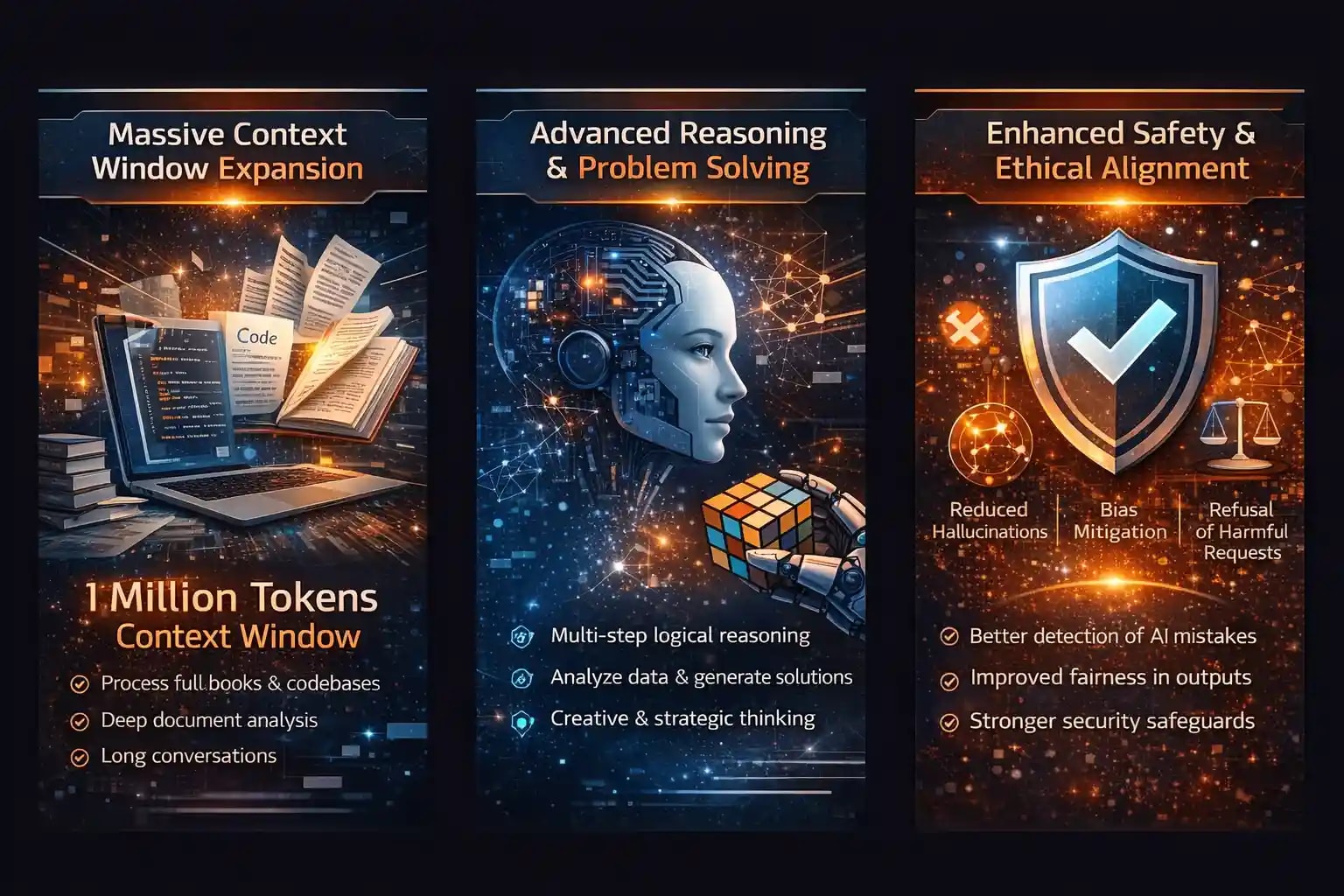
Claude Opus 4.7 context window 1 million tokens,advanced reasoning and problem solving and AI safety and ethical alignment infographic

1. Unprecedented Context Window Expansion

One of the most significant breakthroughs in Claude Opus 4.7 is its dramatically expanded context window. While previous models offered substantial context lengths, Opus 4.7 pushes this boundary to unprecedented levels, allowing it to process and understand vastly larger amounts of information in a single interaction. This means the model can now ingest entire books, lengthy legal documents, extensive codebases, or hours of meeting transcripts and maintain coherence and recall throughout.

Implications for AI Development:

  • Enhanced Document Analysis: Researchers and legal professionals can feed entire case files or scientific papers into the model for summarization, analysis, and insight extraction without the need for chunking or complex workarounds.

  • Improved Conversational AI: Chatbots and virtual assistants powered by Opus 4.7 can remember the entirety of a long conversation, leading to more natural, fluid, and contextually aware interactions. Users won't have to repeat information, and the AI can build a more comprehensive understanding of the user's needs over time.

  • Code Comprehension and Generation: Developers can present larger sections of code for debugging, refactoring, or explanation. The model can understand the relationships between different parts of a complex program, leading to more efficient development cycles.

  • Long-Form Content Creation: Writers and content creators can leverage the expanded context to generate more cohesive and detailed long-form content, ensuring consistency in narrative, tone, and factual accuracy across extended pieces.

2. Advanced Reasoning and Problem-Solving Capabilities

Claude Opus 4.7 exhibits a marked improvement in its reasoning and problem-solving abilities. This enhancement is evident in its capacity for logical deduction, multi-step inference, and creative problem-solving. The model can now tackle more complex analytical tasks that were previously challenging for LLMs.

Key Advancements:

  • Deeper Logical Inference: The model can follow intricate logical chains, identify subtle inconsistencies, and draw more accurate conclusions from complex datasets. This is crucial for applications in fields like scientific research, financial analysis, and strategic planning.

  • Enhanced Mathematical and Scientific Understanding: Opus 4.7 demonstrates a more robust grasp of mathematical principles and scientific concepts, enabling it to assist with complex calculations, interpret experimental data, and even propose hypotheses.

  • Creative Problem-Solving: Beyond analytical tasks, the model shows improved aptitude for generating novel solutions and creative approaches to problems, making it a valuable partner in brainstorming sessions and innovation labs.

3. Next-Generation Safety and Ethical Alignment

Anthropic's commitment to developing safe and beneficial AI is a cornerstone of the Claude family. Claude Opus 4.7 integrates cutting-edge safety features and ethical alignment protocols, building upon the Constitutional AI principles that guide its behavior.

Key Safety Features:

  • Reduced Hallucinations: Through advanced training and fine-tuning, Opus 4.7 significantly reduces the tendency for LLMs to generate factually incorrect or nonsensical information (hallucinations). This is critical for applications where accuracy is paramount.

  • Improved Bias Mitigation: The model incorporates refined techniques to detect and mitigate biases present in training data, leading to fairer and more equitable outputs across diverse user queries and contexts.

  • Enhanced Refusal Capabilities: Opus 4.7 is better equipped to identify and refuse harmful, unethical, or inappropriate requests, reinforcing its role as a responsible AI assistant. This includes more nuanced understanding of harmful content categories.

  • Transparency and Explainability: While still an active area of AI research, Opus 4.7 takes steps towards greater transparency, offering clearer insights into its reasoning process when possible, which aids in debugging and building user trust. The development of more interpretable AI models is a key focus for the industry, and Anthropic's work here is significant. You can learn more about the challenges and progress in AI explainability on resources like Wikipedia's page on Explainable AI.

Revolutionizing AI Development Workflows in 2026

The impact of Claude Opus 4.7 extends directly to the daily workflows of AI developers, researchers, and engineers. Its capabilities streamline processes, accelerate innovation, and enable the creation of more sophisticated AI applications.

Accelerated Prototyping and Development

Developers can leverage Opus 4.7 to significantly speed up the prototyping phase. The model can generate boilerplate code, draft documentation, suggest architectural designs, and even write unit tests based on high-level descriptions. This allows developers to focus more on complex logic and innovative features rather than repetitive coding tasks.

Enhanced Code Review and Debugging

With its deep understanding of code structure and logic, Claude Opus 4.7 can act as an invaluable assistant for code reviews. It can identify potential bugs, security vulnerabilities, and performance bottlenecks that might be missed by human reviewers. Its ability to process large codebases means it can spot cross-module issues more effectively.

Sophisticated Data Analysis and Feature Engineering

For data scientists, Opus 4.7 offers powerful tools for data exploration, analysis, and feature engineering. It can help identify patterns in large datasets, suggest relevant statistical models, and even assist in generating new features for machine learning models, all within a more natural language interface.

Streamlined Research and Experimentation

Researchers can use Claude Opus 4.7 to quickly synthesize information from vast amounts of literature, identify research gaps, and even formulate hypotheses. The ability to process extensive research papers and datasets accelerates the pace of scientific discovery and technological innovation.

Real-World Applications and Industry Impact

The advancements in Claude Opus 4.7 are not confined to theoretical improvements; they translate into tangible benefits across a wide array of industries.

Healthcare and Life Sciences

In healthcare, Opus 4.7 can assist in analyzing complex patient data, identifying potential drug interactions, summarizing medical research, and even aiding in diagnostic processes by cross-referencing symptoms with extensive medical knowledge bases. The ability to process lengthy patient histories and research papers is a game-changer for medical professionals.

Finance and Legal Sectors

The financial industry can benefit from Opus 4.7's enhanced analytical capabilities for market trend prediction, risk assessment, and fraud detection. In the legal field, it can drastically reduce the time spent on document review, contract analysis, and legal research, making legal services more efficient and accessible. For instance, analyzing thousands of pages of discovery documents for relevant evidence becomes a much more manageable task.

Education and Research

Educational institutions can use Opus 4.7 to develop personalized learning plans, create dynamic educational content, and provide advanced tutoring assistance. Researchers can accelerate their work by leveraging the model's capacity to process and summarize vast amounts of academic literature.

Creative Industries and Content Creation

Writers, marketers, and content creators can utilize Opus 4.7 for brainstorming ideas, drafting articles, generating marketing copy, and even assisting in scriptwriting. The expanded context window allows for the creation of more coherent and engaging long-form content.

Software Development and Engineering

As previously mentioned, software developers gain a powerful ally in code generation, debugging, and documentation. Opus 4.7 can help teams build more robust and efficient software faster than ever before. The integration of AI assistants into the development lifecycle is rapidly becoming standard practice.

Case Study: Revolutionizing Customer Support with Claude Opus 4.7

Company: OmniCorp Solutions (Fictional) Industry: Technology Services

Challenge: OmniCorp Solutions, a provider of enterprise software solutions, faced escalating customer support costs and decreasing customer satisfaction due to long wait times and the inability of their existing AI chatbot to handle complex, multi-turn technical queries effectively. Their support agents spent a significant amount of time on repetitive, yet context-dependent, troubleshooting steps.

Solution: OmniCorp implemented Claude Opus 4.7 to power their next-generation customer support platform.

Implementation Details:

  1. Knowledge Base Integration: The entire OmniCorp product documentation, troubleshooting guides, and past support ticket resolutions (anonymized) were fed into Claude Opus 4.7's expanded context window.

  2. Advanced Chatbot Deployment: The AI chatbot was upgraded to leverage Opus 4.7's superior reasoning and conversational memory.

  3. Agent Assist Tool: A supplementary tool was developed, allowing human agents to query Opus 4.7 in real-time with complex customer issues, receiving detailed, context-aware solutions and explanations.

Results:

  • First Contact Resolution (FCR) Rate Increase: Increased by 35% within six months, as the AI could now handle more complex issues end-to-end.

  • Average Handling Time (AHT) Reduction: Decreased by 20% for issues handled by the AI and 25% for issues escalated to human agents, thanks to the Agent Assist tool providing faster, more accurate information.

  • Customer Satisfaction (CSAT) Score Improvement: Rose by 15 points, attributed to faster response times, more accurate solutions, and a more natural conversational experience.

  • Support Agent Efficiency: Agents reported higher job satisfaction due to reduced handling of routine queries and better support from the AI assistant for complex problems.

Key Takeaway: By leveraging the expanded context window and advanced reasoning of Claude Opus 4.7, OmniCorp Solutions transformed its customer support operations, achieving significant improvements in efficiency, cost-effectiveness, and customer satisfaction. This case highlights the tangible business value unlocked by cutting-edge LLM advancements.

The Future of AI Development with Claude Opus 4.7

Claude Opus 4.7 represents a significant leap forward, but it also serves as a stepping stone for future AI development. The innovations introduced in this version will likely pave the way for even more sophisticated models.

Towards More General AI Capabilities

The enhanced reasoning and context handling of Opus 4.7 bring us closer to AI systems with more general intelligence – systems that can learn, adapt, and solve problems across a wider range of domains with minimal task-specific training.

Increased Human-AI Collaboration

As AI models become more capable and trustworthy, the potential for seamless human-AI collaboration grows. Opus 4.7's ability to understand complex instructions and provide nuanced responses makes it an ideal partner for creative endeavors, scientific research, and complex decision-making processes. The future likely involves AI not just as a tool, but as a collaborative partner.

Ethical AI as a Standard

The continued emphasis on safety and ethical alignment in models like Claude Opus 4.7 sets a precedent for the industry. As AI becomes more integrated into society, the demand for responsible, unbiased, and secure AI systems will only increase. Anthropic's approach, focusing on safety from the ground up, is becoming a model for ethical AI development globally. According to The Future of Life Institute, ensuring AI safety is paramount for long-term societal well-being.

Challenges and Considerations

Despite the revolutionary advancements, deploying and utilizing Claude Opus 4.7 comes with considerations:

  • Computational Resources: Running and fine-tuning such advanced models requires significant computational power, which can be a barrier for smaller organizations.

  • Data Privacy and Security: Handling large datasets, especially sensitive information, necessitates robust data privacy and security protocols.

  • Over-reliance and Critical Thinking: Ensuring users maintain critical thinking skills and do not become overly reliant on AI outputs is crucial. AI should augment, not replace, human judgment.

  • Interpretability: While improvements are being made, fully understanding the decision-making process of complex LLMs remains a challenge in AI research. This is an area where continuous research is vital.

Optimizing Your Use of Claude Opus 4.7

To maximize the benefits of Claude Opus 4.7, consider these optimization strategies:

  • Clear and Specific Prompting: The quality of output directly correlates with the quality of input. Develop clear, detailed prompts that guide the AI effectively.

  • Iterative Refinement: Treat interactions with Opus 4.7 as a dialogue. Refine your prompts based on the AI's responses to achieve the desired outcome.

  • Leverage the Expanded Context: Design tasks that take full advantage of the massive context window for tasks like summarizing lengthy documents or analyzing extensive code.

  • Integrate with Existing Workflows: Identify specific bottlenecks in your current processes where Opus 4.7's capabilities can provide the most significant impact.

  • Stay Updated on Best Practices: The field of AI is evolving rapidly. Keep abreast of new techniques and best practices for interacting with and deploying advanced LLMs. Resources from organizations like OpenAI often provide valuable insights into interacting with advanced AI models.

Claude Opus 4.7: A Checklist for Developers and Businesses

To help you assess readiness and plan for the integration of Claude Opus 4.7, consider this checklist:

Technical Readiness

  • Assess current infrastructure for computational requirements (GPU, memory).

  • Evaluate API access and integration capabilities.

  • Review data security and privacy protocols for handling large datasets.

  • Identify necessary software updates or new tools for seamless integration.

Application Development

  • Define specific use cases where Opus 4.7's advanced features offer the most value.

  • Develop prompt engineering strategies tailored to Opus 4.7's capabilities.

  • Plan for testing and validation of AI-generated outputs, especially in critical applications.

  • Consider fine-tuning strategies if specific domain expertise is required.

Team Training and Adoption

  • Conduct training sessions on prompt engineering and effective AI interaction.

  • Educate teams on the ethical considerations and limitations of AI.

  • Foster a culture of human-AI collaboration.

  • Establish feedback mechanisms for continuous improvement of AI integration.

Safety and Ethics

  • Review Anthropic's safety guidelines and best practices for Opus 4.7.

  • Implement checks and balances to mitigate potential AI biases.

  • Develop protocols for handling unexpected or inappropriate AI outputs.

  • Ensure compliance with relevant data protection and AI regulations.

Conclusion

Claude Opus 4.7 represents a monumental stride in artificial intelligence development for 2026. Its revolutionary upgrades in context window size, reasoning capabilities, and safety protocols are not just technical achievements; they are enablers of unprecedented innovation across industries. From accelerating complex research to revolutionizing customer interactions and streamlining software development, the impact of Opus 4.7 is profound and far-reaching.

As organizations embrace this powerful new tool, the focus must remain on responsible deployment, ethical considerations, and fostering a collaborative environment where human ingenuity is augmented, not replaced, by artificial intelligence. The journey with Claude Opus 4.7 is just beginning, promising a future where AI development is more powerful, more accessible, and more aligned with human values than ever before.